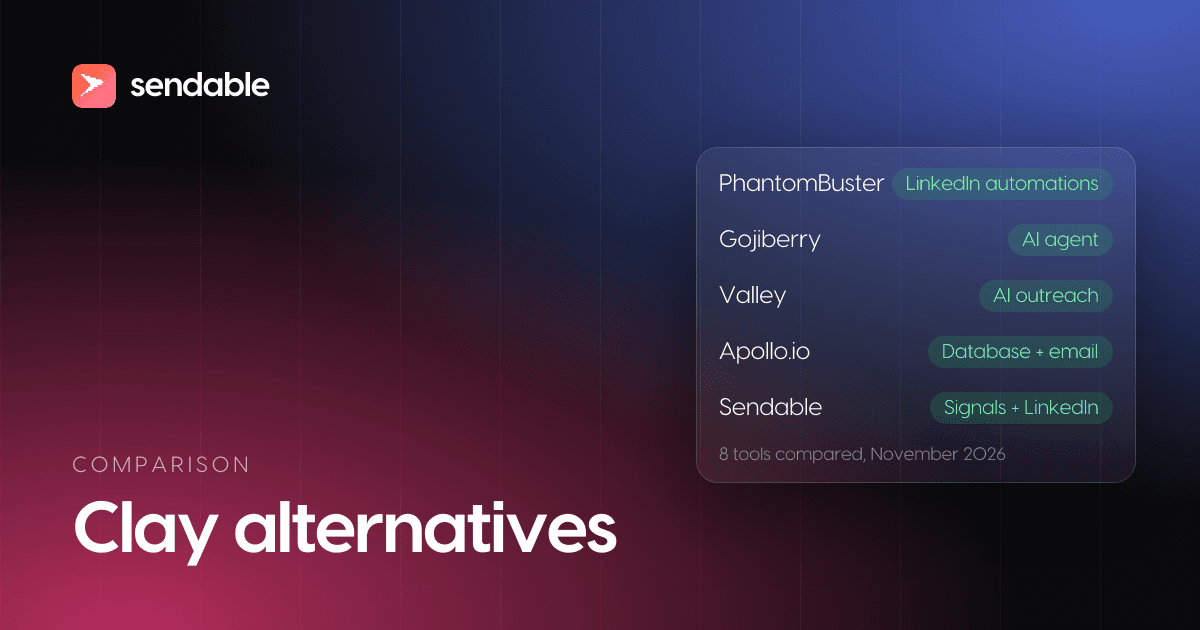
The best Clay alternative for LinkedIn prospecting depends on which Clay job you want to replace. To find prospects on LinkedIn and contact them from the same tool: PhantomBuster if you like building automations, Gojiberry or Valley if an AI agent should write the messages, Sendable if you write the sequence and want every lead qualified by AI with a reason. For a contact database, Lusha or Apollo. For emails and phones alone, FullEnrich. Stay with Clay if you run multi-provider waterfalls, Claygent research or CRM enrichment.
Full disclosure: I build Sendable, one of the eight tools below. It sits sixth, where the ranking rule stated before the list puts it, not first. Every price and feature comes from the vendor's own site, opened on November 3, 2026, and every Sendable feature was checked in its code.
My verdict: Clay is a data workshop, not a LinkedIn outreach tool. It builds, enriches and researches the list, then hands it to a sender such as HeyReach. So the useful question is not which tool copies Clay, but which half of that workflow you want to replace: the data half, the LinkedIn half, or both.
What Clay does, and what it costs in November 2026
Clay is a data enrichment and workflow platform: a table where each row is a company or a person, and each column fetches data from a provider, an AI model or another tool. In its pricing announcement of March 11, 2026, it calls itself "an end-to-end GTM Engineering tool". For LinkedIn prospecting, it does five things:
- Search: "Run unlimited search with Audiences", from the Launch plan, to start a table from companies or people.
- Enrichment: "Find and enrich data from 150+ providers", with "multi-provider waterfalls" that try one provider after another until an email or a phone number comes back. Clay says a waterfall "lifts email coverage from roughly 30% with a single provider to around 80%".
- Claygent: "Clay's AI agent with access to web research. Generate custom data points with AI", used to research or qualify each row.
- Signals: from Launch, "signals on job change, promotions, new hires, company news, and social"; Growth adds web intent. Its social signals page says it "monitors LinkedIn, Reddit, X, and YouTube for keyword matches".
- Routing: email campaigns through "Clay's email sequencer or a sequencing integration", CRM sync from Growth, and "Send ad audiences to LinkedIn and Meta", also on Growth.
What it does not do is send a LinkedIn invitation or message. Its HeyReach integration guide reads: "Within Clay, you can use HeyReach to add leads directly to your campaigns", and "Campaigns cannot be created from within Clay." The sequence lives in a second tool, with its own subscription.
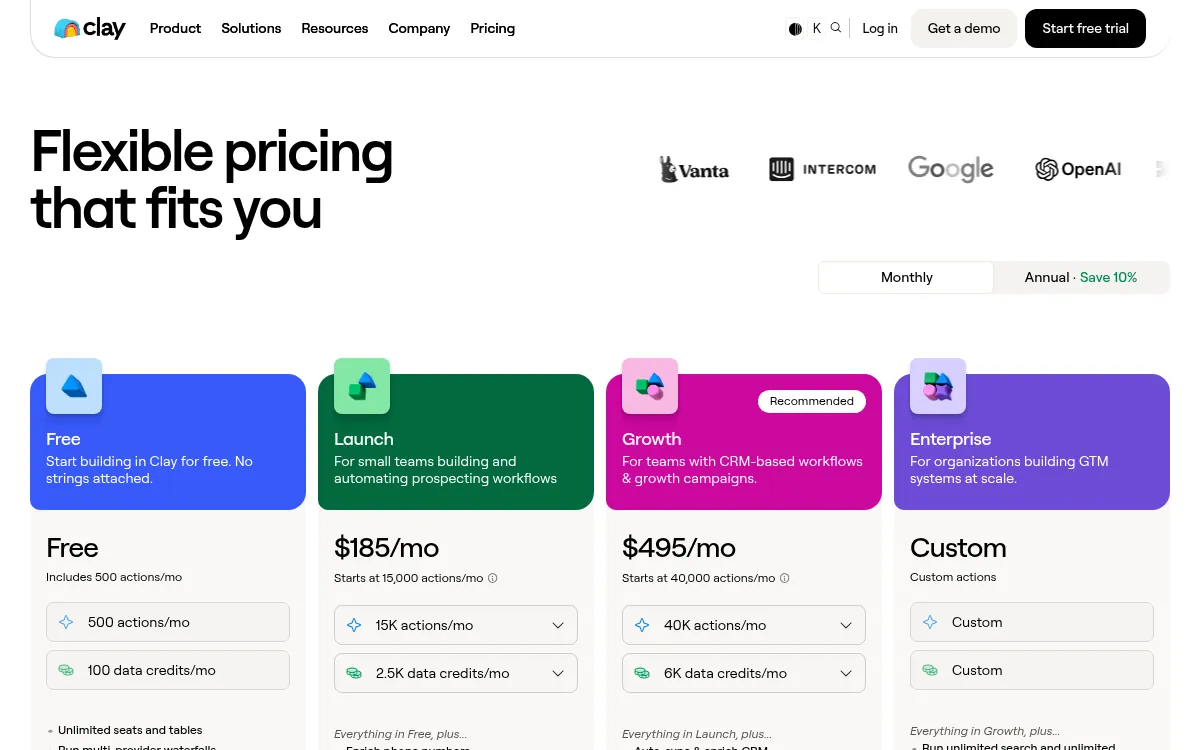
Plans from Clay's pricing page, checked on November 3, 2026, in US dollars per month:
| Plan | Monthly billing | Yearly billing | Actions a month | Data credits a month | What it adds |
|---|---|---|---|---|---|
| Free | $0 | $0 | 500 | 100 | Unlimited seats and tables, waterfalls, Claygent, 200 rows per table, no phone numbers |
| Launch | $185 | $167 | 15,000 | 2,500 | Phone numbers, Audiences search, job change and other signals, email sequencer |
| Growth | $495 | $446 | 40,000 | 6,000 | CRM sync, web intent signals, HTTP API, webhooks, ad audiences, priority support |
| Enterprise | Custom | Custom | Custom | Custom | SSO, role-based access, unlimited Audiences imports, a dedicated growth strategist |
It bills on two meters. In its own words, "Actions measure platform usage: enrichment & GTM execution" and "Data credits buy data & AI from vendors in Clay's marketplace." The Launch price is two sliders added together: 15,000 actions for $60 and 2,500 data credits for $125. Moving either one raises the bill; 6,000 data credits on Launch cost $290 instead of $125.
The rest of the rules, from the same page and its FAQ:
- Data credits "start at $0.05 each"; actions "start at less than $0.01 each".
- "If an enrichment returns no result, you're not charged Data Credits or Actions."
- Actions "reset each billing cycle and don't roll over". Unused data credits roll over up to twice the monthly amount on Launch and Growth.
- Extra credits between billing cycles cost "a 30% premium".
- Every plan has unlimited seats, and the Free plan needs no credit card. Launch and Growth start with a 14-day trial.
The pricing changed on March 11, 2026. The company cut the price of the data in its marketplace by 50 to 90% and the top-up premium "from 50% to 30%", moved CRM sync and web intent to the new $495 Growth plan, and let existing customers keep the old Starter, Explorer and Pro plans. It also warned that "Customers who predominantly use their own API keys or are on Pro plans may see a price increase." Pages that still quote $149 or $800 a month are quoting those legacy plans.
Why do people look for a Clay alternative?
It has loyal users among growth and operations teams, and several of the pages that rank for this search, written by its competitors, concede that its waterfall and Claygent are hard to match. People leave it over four things, each documented by the company itself or by its reviewers.
- It sends nothing on LinkedIn. Its own guide says campaigns "cannot be created from within Clay": the invitation and the follow-ups run in HeyReach, La Growth Machine or another sender. At HeyReach's $79 per sender a month, checked in our HeyReach alternatives comparison, Launch plus one sender costs $264 a month before the first message.
- Two meters to forecast. The bill follows the rows you run and the enrichments on each row. On Trustpilot, a user wrote in October 2026 that "all my credits got burnt within 5 minutes". Another, on the Growth plan, wrote that "AI showed samples were working fine and after spending another $1500 to process all my data" the run did not follow the instructions, and that "customer service refused to reinstate my credits".
- A build surface with a learning curve. The company says its goal is to be "your default tool for GTM Engineering". A reviewer wrote in September 2026: "Extremely difficult to use, not intuitive at all."
- CRM sync and web intent cost $495. On Launch, there is no CRM sync, no HTTP API, no webhook signals and no web intent: those start on Growth.
It rates 2.7 out of 5 on Trustpilot from 27 reviews, 63% of them one star (read on November 3, 2026). The profile is not claimed by the company and the sample is small, and G2 refused automated access, so read reasons 2 and 3 as risks to test in a trial, not as verdicts.
The 8 Clay alternatives at a glance
Prices checked on November 3, 2026, on monthly billing, in the vendor's currency. Sendable bills in euros: at the European Central Bank rate of November 3, 2026 (1 EUR = 1.1179 USD), €59 is about $66.
| Tool | Replaces in Clay | Sends on LinkedIn | Billed per | Entry price, a month | Best for |
|---|---|---|---|---|---|
| Clay (reference) | Nothing, it is the reference | No | Plan, actions, data credits | $185 (Launch) | Custom data workflows across 150+ providers |
| PhantomBuster | Lists, signals, AI scoring, emails | Yes | Plan, unlimited users | $69 (Start) | Building your own LinkedIn automations |
| Gojiberry | Signals, scoring, emails and phones | Yes, written by an AI agent | Plan, 2 LinkedIn accounts | $99 (Pro) | An AI agent that finds and writes for one or two accounts |
| Valley | Signals, qualification, research | Yes, in your voice | Seat | $199 per seat (Starter) | AI-written LinkedIn outreach with research on each prospect |
| Lusha | Contact data, signals, ICP scoring | No | Plan, credits | $49.90 (Starter) | Emails and phones revealed while you browse LinkedIn |
| Apollo.io | Contact data, AI research, email sequences | Not on its pricing page | Seat, credits | $65 per seat (Basic) | Contact data and email sequences in one tool |
| Sendable | Signals, AI qualification | Yes, sequences you write | Connected account | €59 (about $66) per account | Prospects found from LinkedIn signals and qualified with a reason |
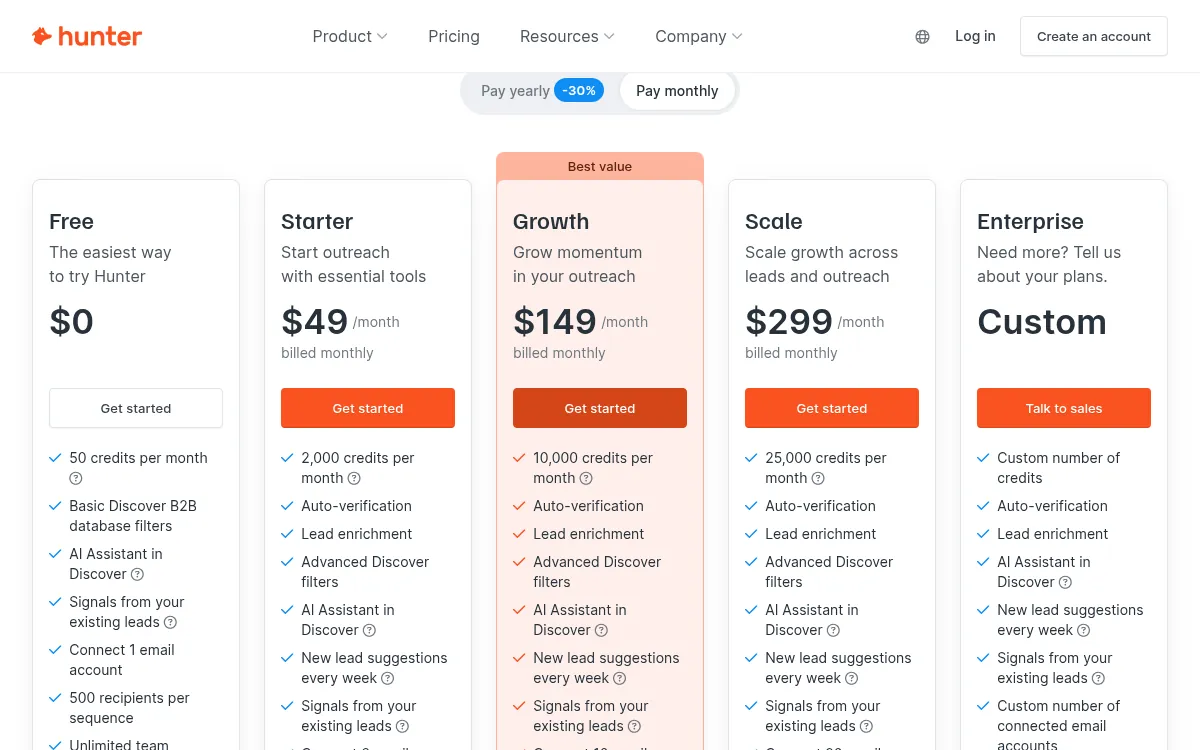
| Hunter | Work emails, company database | No | Plan, credits | $49 (Starter) | Work emails and cold email on a small budget |
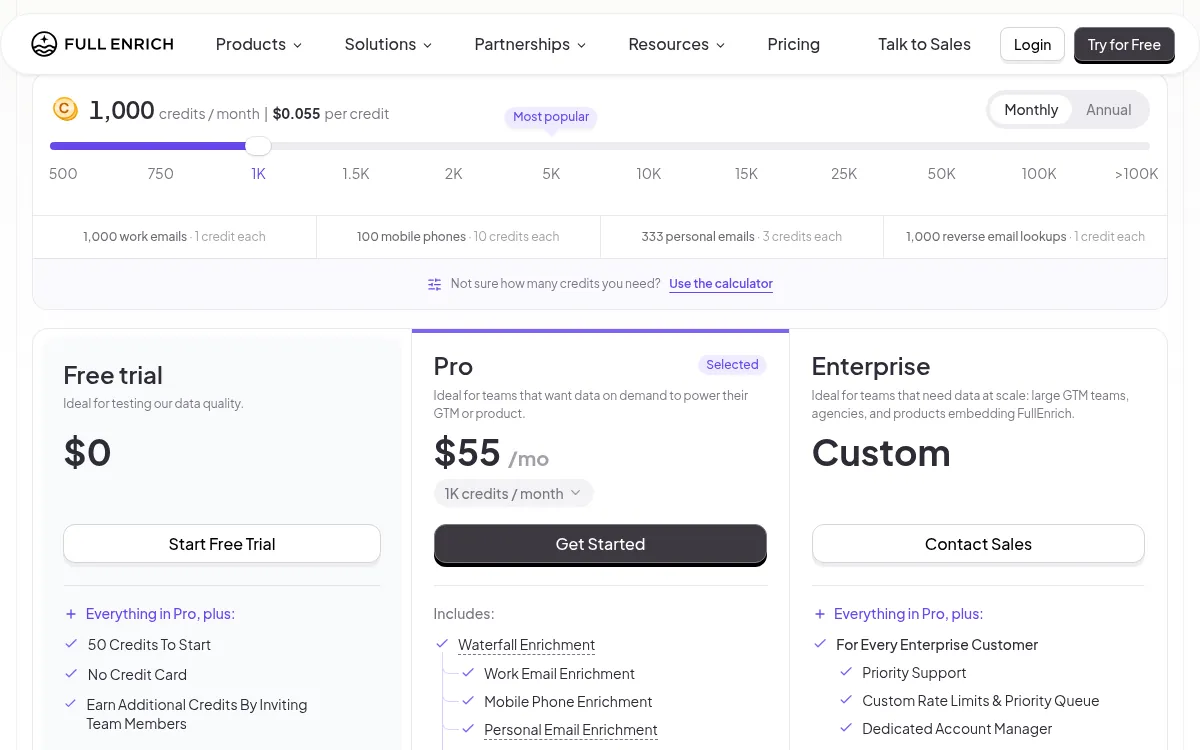
| FullEnrich | Email and phone waterfall | No | Credits | $29 (Pro, 500 credits) | Emails and phones only, paid when found |
The first question to settle: do you want to keep a sender next to your data tool, as with Clay, or should one tool find the people and contact them? PhantomBuster, Gojiberry, Valley and Sendable do both; Lusha, Apollo, Hunter and FullEnrich give you the data and leave the sending to you.
Which Clay jobs each alternative replaces
Five jobs make up a Clay workflow for LinkedIn prospecting. "Yes" means the vendor's own site documents the job on November 3, 2026, paid plans and add-ons included; "No" means its site does not document it.
| Tool | Builds the list | Timing signals | AI research or scoring | Email or phone | Sends on LinkedIn |
|---|---|---|---|---|---|
| Clay (reference) | Yes, Audiences search | Job changes, news, social listening; web intent on Growth | Yes, Claygent | Yes, 150+ providers | No, through another tool |
| PhantomBuster | Yes, LinkedIn and Sales Navigator lists | Job changes, post engagement | Yes, AI Phantoms score and segment | Yes, email credits | Yes |
| Gojiberry | Yes, signals and lookalikes | Competitor engagement, your followers, website visitors | Yes, every prospect scored on your ICP | Yes, email and phone, 15+ providers | Yes |
| Valley | Yes, its playbooks or your own list | Profile viewers, post engagement, hiring, a competitor's audience | Yes, ICP scoring and research | Yes, email from the Plus plan | Yes |
| Lusha | Yes, 515M+ contacts | 26 signal types, job change included | Yes, ICP fit and signal scores | Yes, email and phone | No |
| Apollo.io | Yes, 240M+ contacts | Intent topics, website visitors | Yes, AI Research and lead scoring | Yes, email and phone | No |
| Sendable | Yes, searches on your filters | 14 signals | Yes, a verdict and a reason per person | No, only with your own FullEnrich account | Yes |
| Hunter | Yes, Discover database | Signals on your existing leads | No | Yes, email only | No |
| FullEnrich | Yes, people and company search | No | No | Yes, 25+ sources | No |
Three tools do all five jobs: PhantomBuster, Gojiberry and Valley. Clay does four of them; the fifth, sending on LinkedIn, is the one it leaves to HeyReach or another sender. The table counts what each site documents, not how deep each job goes: no alternative here matches its 150+ providers in one waterfall.
How I picked and ranked these tools
I read the eight pages that rank for "clay alternative" and for its LinkedIn version: Cognism's, Salesforge's, Bloomberry's, The GTM Directory's, Valley's, Gojiberry's, PhantomBuster's and FlowHunt's. Most are written by a vendor that lists itself first. Three conditions decided who is on this page:
- It finds B2B prospects itself: a contact database, a LinkedIn search or signals.
- Its price is public on its own site, checked on November 3, 2026.
- At least four of the eight pages name it, or its vendor wrote one of the eight pages and it finds people from LinkedIn signals and contacts them there, the job this page is about. Apollo (eight pages), Lusha (five), Hunter (four) and FullEnrich (four) qualify by the first route; PhantomBuster, Gojiberry and Valley by the second. Sendable is in because I build it.
Cognism (six pages) and ZoomInfo (four) publish no price, so they are not ranked.
The ranking is mechanical. A tool scores one point for each of the five jobs in the table above that its site documents. Inside a score, the public monthly price of the first paid plan for one user and one LinkedIn account breaks the tie. That gives PhantomBuster, Gojiberry and Valley 5 points, Lusha, Apollo and Sendable 4, Hunter 3 and FullEnrich 2.
This is one of nine alternatives pages built on the same method. The comparison hub sets Clay next to the LinkedIn senders and signal tools the others cover, with who should leave each one and why.
1. PhantomBuster
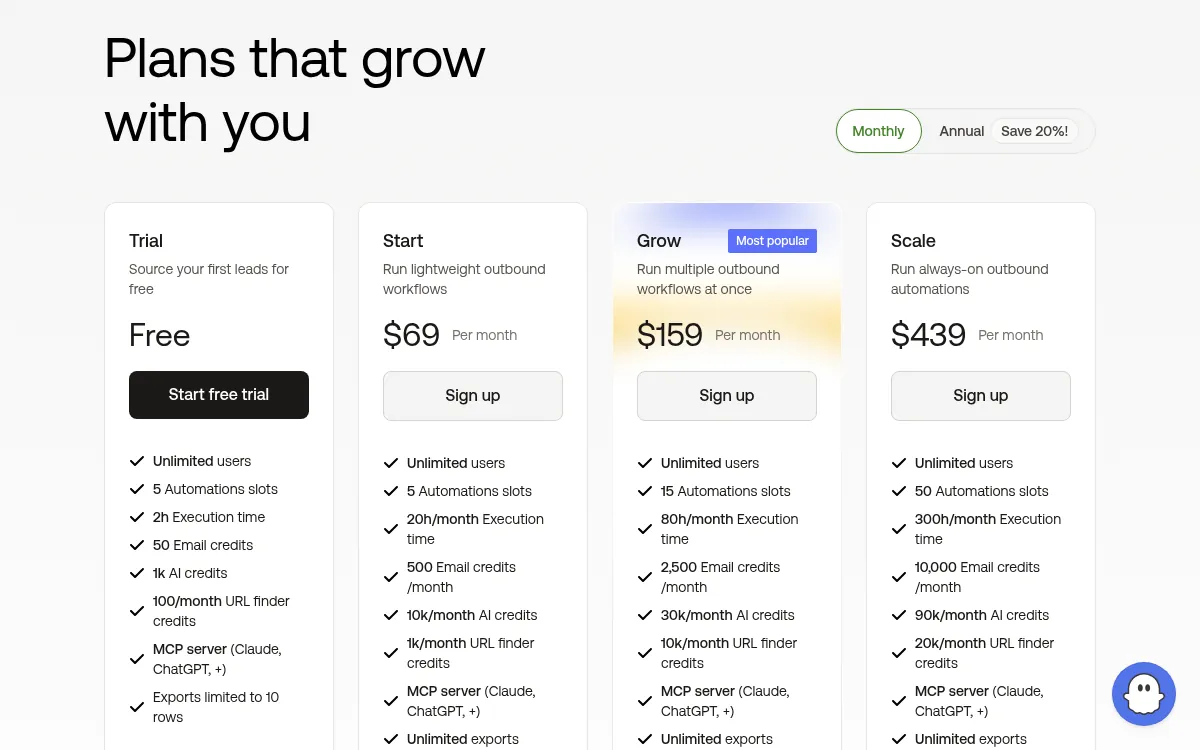
PhantomBuster is a library of automations, called Phantoms, that extract and act on LinkedIn and "15+ platforms". It says it can "Segment and enrich lists with 1,000+ live data points, from job changes to profile activity", and that its "AI Phantoms can be used to clean data (e.g. job titles), or score and segment your leads." Its workflows chain Phantoms, for example "finding people who engaged with a LinkedIn post, collecting their profiles, and exporting them to your CRM". Then it can "trigger outreach flows including DMs, connection requests, likes, or event invites". Every plan lists Sales Navigator automation, email enrichment, AI filtering and writing, and several connected accounts.
Price (checked November 3, 2026): Start at $69 a month (5 automations at a time, 20 hours of execution time, 500 email credits, 10,000 AI credits), Grow at $159 (15 automations, 80 hours) and Scale at $439 (50 automations, 300 hours), or 20% less billed yearly. Users are unlimited. The 14-day free trial needs no credit card and limits exports to 10 rows.
Best for: someone who already thinks in Clay tables and wants the same building logic, on live LinkedIn data, with sending included.
Limits: you pay in automations and hours of execution, so the capacity depends on how you chain Phantoms; it sells no database ("PhantomBuster does not sell, resell, or provide pre-built databases"), and you build each workflow yourself. More on the PhantomBuster alternatives page.
2. Gojiberry
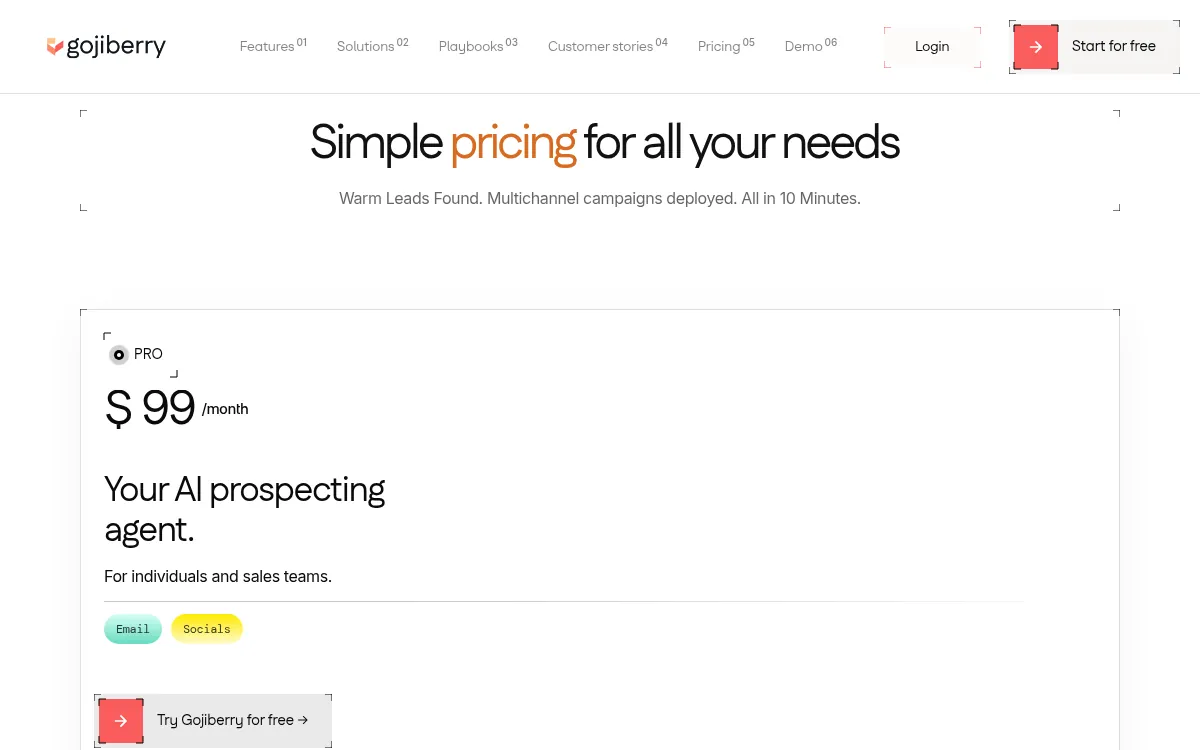
Gojiberry sells an AI sales agent rather than a table. The agent "detects buying & social signals, scores every prospect against your ideal customer", among them competitor engagement, people who follow your company and people active in your space, plus lookalikes of your best customers and website visitors. It then writes and sends LinkedIn messages and emails, visits profiles and sends connection requests, in full auto or after your approval ("Full auto or approve before it sends"). The Pro plan adds a unified inbox and email and phone waterfall enrichment across "15+ data providers".
Price (checked November 3, 2026): Pro at $99 a month with 2 AI agents, 2 LinkedIn accounts, up to 1,800 prospects contacted a month and 200 credits. Its help center lists $59 a month for each extra AI Outreach Agent, which adds one LinkedIn sender. A free trial is offered; its length is not stated.
Best for: one or two people who want the agent to find, write and send on LinkedIn and email, without building anything.
Limits: you do not build the sequence or write the messages yourself, and there is no table to add your own columns. More on the Gojiberry alternatives page.
3. Valley
Valley "finds the right prospects, researches what matters to them, crafts relevant messaging, and sends outreach in your voice". You pick a play: "people engaging with your content, companies hiring, a competitor's audience, or your own list". Its homepage lists the jobs it takes over: list building, profile viewers, post engagement and company signals, then ICP scoring, qualification, contact enrichment and research on each prospect, and sequences with follow-ups. For ICP scoring and qualification, the tool it names as the one it replaces is Clay. Every plan includes a unified inbox and CRM, API and MCP integrations.
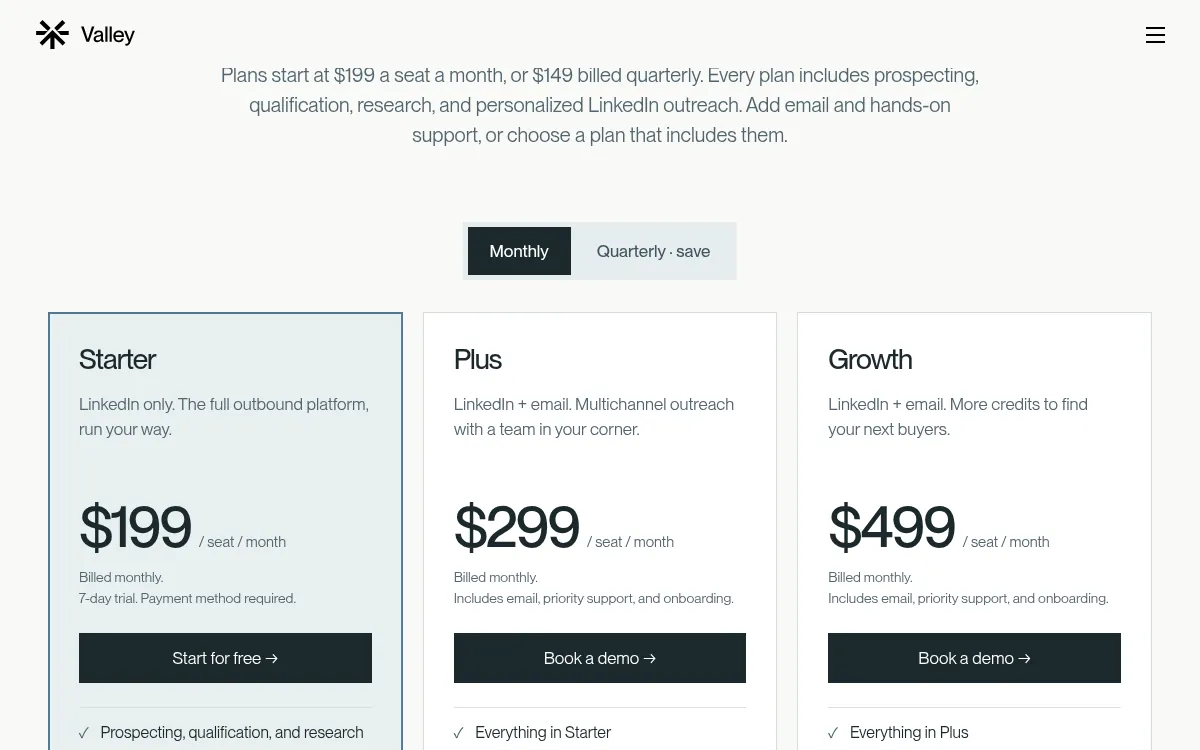
Price (checked November 3, 2026): Starter at $199 per seat a month (LinkedIn, with email as a paid add-on), or $149 billed quarterly; Plus at $299 (email included, 1,000 emails a month and email waterfall enrichment across 15+ providers); Growth at $499 (adds $300 of credits a month). The 7-day trial asks for a payment method. Prices were "updated 19 Oct 2026", according to the page.
Best for: a seller who wants each message researched and written for them, and who can justify the price per seat.
Limits: $199 per seat is the highest entry price on this list, and email costs extra on Starter; it is included from Plus at $299.
4. Lusha
Lusha is a contact database with "515M+ verified contacts, 29M+ companies and 26 dated buying signal types", according to its facts page, updated October 25, 2026. Its signals include job changes and promotions, funding, leadership changes and "LinkedIn activity intent"; its scoring adds an "ICP Fit Score" and lookalikes. The Chrome extension "Reveals contacts on LinkedIn, Sales Navigator and company sites" on every plan. An email costs 1 credit and a phone 5; from Pro, a data waterfall fills the gaps where Lusha has no match. On data sources, the same page says "Lusha does not scrape professional networks or social platforms".
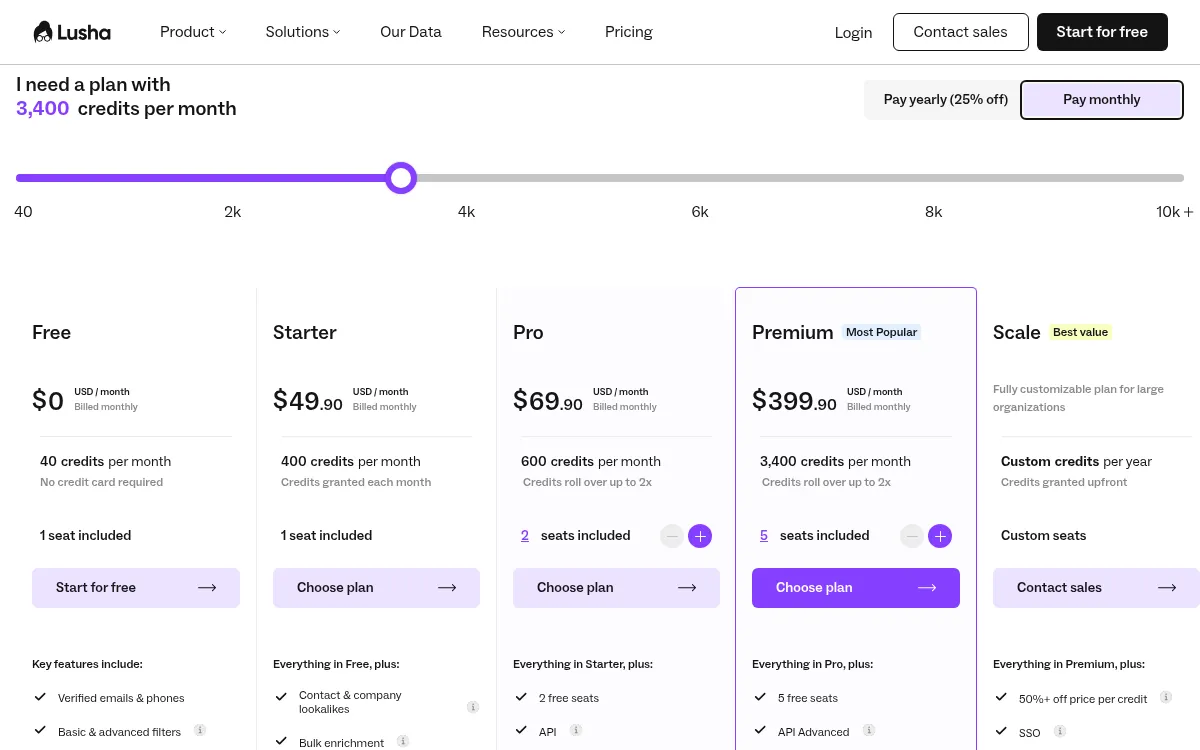
Price (checked November 3, 2026): Free with 40 credits a month and no card, Starter at $49.90 a month (400 credits), Pro at $69.90 (600 credits, 2 seats, signals and API) and Premium at $399.90 (3,400 credits, 5 seats), or 25% less billed yearly. Credits roll over up to twice the monthly amount from Pro.
Best for: reps who prospect on LinkedIn by hand and want the email and the mobile number of the profile they are looking at.
Limits: no LinkedIn outreach (its outreach is automated email sequences), and 400 credits a month is about 80 phone numbers.
5. Apollo.io
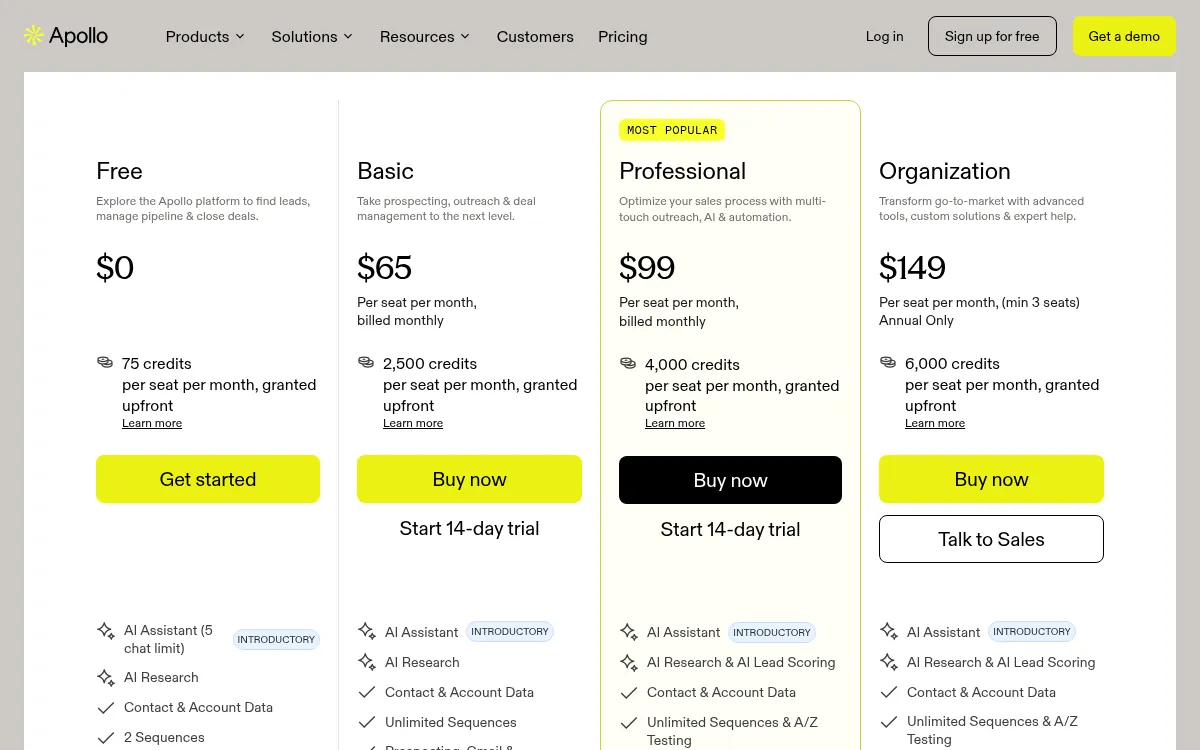
Apollo.io is the tool every one of the eight ranking pages names. It holds "240M+ contacts and 30M+ accounts", and each seat combines search, enrichment, intent topics, website visitor identification, "AI Research" and email sequences. From Basic, it adds waterfall enrichment, CRM integrations and automated CRM enrichment. An email costs 1 credit, a phone number 8, and an AI research run 1. Its pricing page names LinkedIn among its integrations but lists no automated steps there in its sequences.
Price (checked November 3, 2026): Free with 75 credits per seat a month and 2 sequences; Basic at $65 per seat a month (2,500 credits); Professional at $99 (4,000 credits, AI lead scoring); Organization at $119 per seat billed yearly, 3 seats minimum. Yearly billing takes about 24% off. Credits "do not roll over if unused". 14-day trial on Basic and Professional.
Best for: a team that wants the contact data and the email sequence in one subscription, and does its LinkedIn steps by hand.
Limits: credits are per seat and expire each month, and a team that wants automated invitations still adds a sender.
6. Sendable
This is the product I am building. Read this entry with that in mind, and judge it with a trial rather than on my word.
Sendable, signal-based LinkedIn outreach does the LinkedIn half of a Clay workflow in one tool, as checked in its code on November 3, 2026:
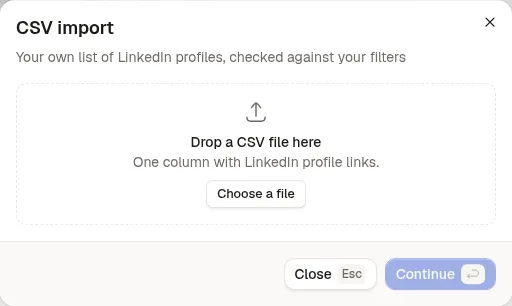
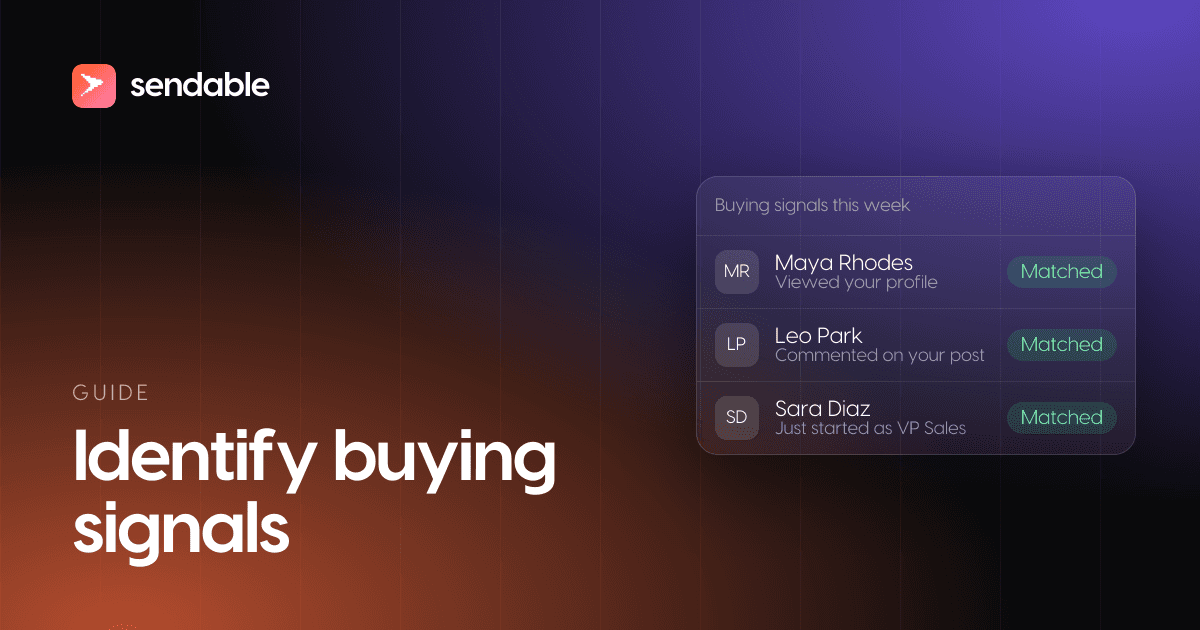
- 14 signals find the people. Job postings, changed jobs (a new role in the last 90 days), active on LinkedIn, post interactions, a keyword tracker, influencer and company engagement (people engaging with posts from profiles or competitor pages you pick), poll voters, profile viewers, profile and company followers, newsletter subscribers, event attendees, first-degree connections and people you may know. A CSV of LinkedIn profiles works too.
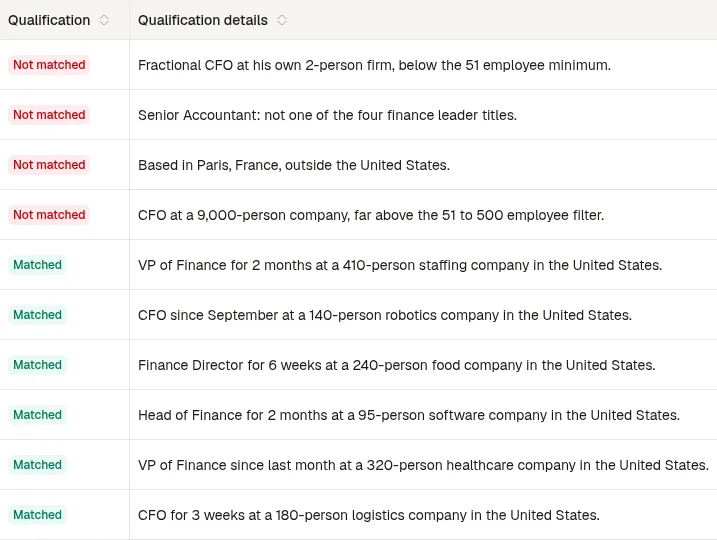
- An AI qualifies each person. It checks the profile against your ideal customer (job title, seniority, company size, sector, location, language, time in the position) and writes one sentence on why the person matches or not. When you reject a lead, you say why, and the signal remembers up to 20 rules for the next ones.
- A sequence you write contacts them. Visits, invitations, likes, messages with variables, a condition on acceptance, withdrawal of unanswered invitations and A/B tests, from your account, within your days, hours and daily limits (30 invitations a day by default). A reply stops the sequence.
The keyword tracker and job post tracker guides show two signals end to end.
Price (checked November 3, 2026): €59 a month per connected account (about $66), or €590 a year, with no tiers. Each account includes 500 credits a month, one credit per person who matches your ideal customer; rejections are free. A team runs up to 5 signals at once. A list you import straight into a campaign, such as a Clay export, uses no credits. The 7-day trial needs a card and charges nothing before it ends; it includes 20 credits, one account and 3 signals. Every plan detail is on the pricing page.
Best for: founders and small B2B teams who used Clay mainly to decide who to contact on LinkedIn, and who want the people found, checked and contacted in one place.
Limits: no waterfall enrichment, no web research and no email. The full list is below.