The cost of lead generation is what you spend to win one new prospect, and it has no single price: it depends on the channel, on what you count as a lead and on which costs you add up. As a reference point, US search ads cost a median $66.69 per lead on Google and Microsoft Ads, and $93.69 for business services, across 13,474 campaigns run from April 2025 to March 2026 (WordStream, 2026). A full-time sales development rep (SDR) costs about $126,000 in the first year, or at least $1,050 per meeting held at a typical quota.
Those two figures don't measure the same thing: a search lead is a form or a call, an SDR's output is a meeting. So this guide puts every channel on the same ladder (cost per lead, per qualified lead, per meeting, per customer), gives the formulas, and builds a budget backwards from the customers you need.
I'm Thomas Bonfils, cofounder of Sendable, a LinkedIn prospecting tool, so weigh the Sendable section accordingly: its prices and rules were checked in Sendable's code on November 12, 2026, and every other figure links to its source.
My verdict: compare channels on cost per qualified lead or per meeting, never on the headline cost per lead. A cheap contact who never fits your customer profile is the most expensive one you buy.
How much does lead generation cost by channel?
There is no single price: published figures run from about $67 per search ad lead to about $126,000 a year for a sales rep, and each channel prices a different unit. The table lists the main ways B2B teams generate leads, with the unit each one is priced in.
| Channel |
Published cost |
What you get for it |
Source |
| Search ads, all industries (US) |
$66.69 per lead, median |
A conversion the advertiser counts: a form, a call |
WordStream 2026 |
| Search ads, business services (US) |
$93.69 per lead, median |
The same, with 4.85% of clicks turning into leads |
WordStream 2026 |
| Search ads, industrial and commercial (US) |
$75.19 per lead, median |
The same, with 8.20% of clicks turning into leads |
WordStream 2026 |
| Full-time SDR (US) |
About $126,000 in the first year |
Meetings held, against a median quota of 10 a month |
Bridge Group 2025, BLS, SHRM |
| Managed LinkedIn outreach |
About €1,500 to CHF 4,500 a month among services that publish a price; Sendable Done for you: $1,500 a month |
A team builds the lists and runs your outreach; you take the meetings |
Providers' sites, Nov. 2026 |
| LinkedIn prospecting software (Sendable) |
$69 per LinkedIn account a month on Pro |
Up to 500 leads a month that match your ideal customer, with the campaigns and inbox you run |
Sendable pricing |
Read the third column before comparing prices. A search ad conversion is anyone who filled in a form or called, whether or not they fit your customer profile. An SDR's cost buys meetings held. A Sendable credit buys a person a signal found and the AI matched to your ideal customer, before that person has accepted an invitation or replied. To compare two rows, bring both to the same stage, as the next section does.
WordStream's figures count ad spend only: no agency fee, no landing page work, no staff time. The SDR and managed outreach rows are broken down line by line in our guide to managed outreach cost.
How do you calculate cost per lead and cost per qualified lead?
Divide what you spent by what you got, at one stage of the funnel, over one period. Cost per lead divides spend by every contact; cost per qualified lead divides it by the contacts that meet the criteria you set before the campaign, such as role, company size, sector or need. State which costs you counted every time you report the figure.
| Metric |
Formula |
What it tells you |
| Cost per lead (CPL) |
Spend ÷ leads |
What a contact costs on this channel |
| Cost per qualified lead |
Spend ÷ leads that meet your criteria |
What a contact your sales team wants costs |
| Cost per meeting |
Spend ÷ meetings held |
What a sales conversation costs |
| Customer acquisition cost (CAC) |
All sales and marketing costs ÷ new customers |
What a customer costs, every channel included |
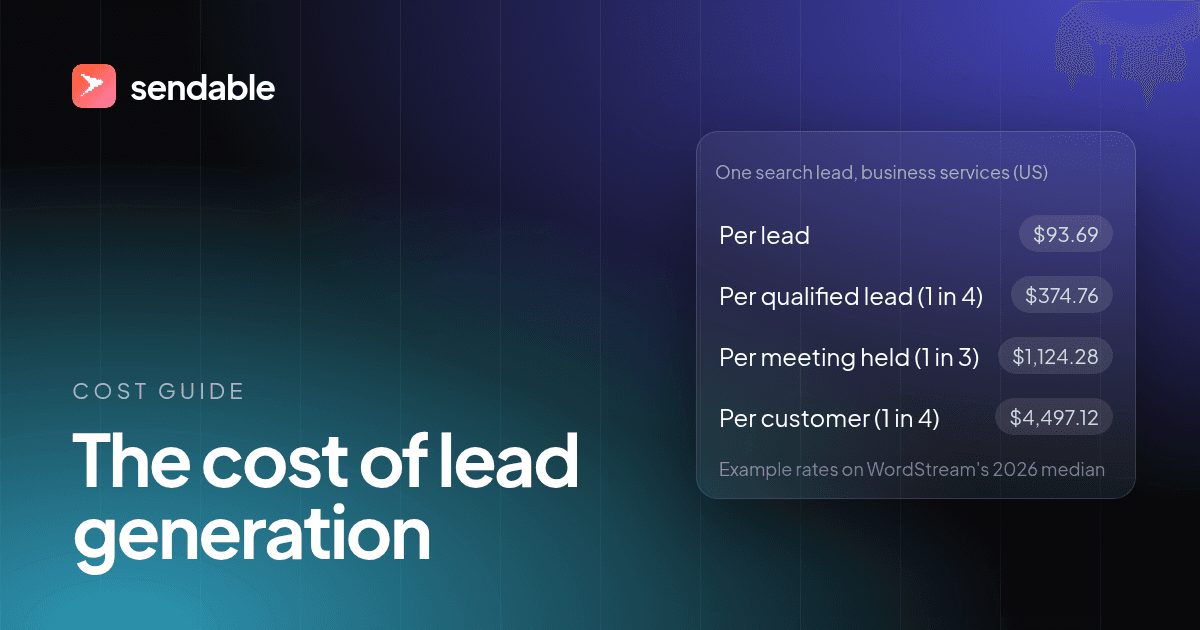
Each stage divides by a smaller number, so the cost climbs fast. Take the business services median of $93.69 per search lead and three conversion rates picked for the example (replace them with yours):
| Stage |
Example rate |
Cost at this stage |
| Lead |
WordStream median, business services |
$93.69 |
| Qualified lead |
1 lead in 4 meets your criteria |
$374.76 |
| Meeting held |
1 qualified lead in 3 books and attends |
$1,124.28 |
| Customer |
1 meeting in 4 becomes a customer |
$4,497.12 |
At those rates, the search channel that looked cheap costs about as much per meeting as a full-time SDR at quota: $126,000 a year spread over 120 meetings held is $1,050 a meeting. Change one rate and the ranking flips, which is why the qualification threshold has to be fixed before you compare channels, and applied the same way to each one.
Label every figure as channel-only or fully loaded. A channel-only cost counts media or fees alone; a fully loaded cost adds a share of staff time, software, data and management. Set a vendor's media-only figure against your fully loaded one and your own channel will look worse than it is.
What do published cost per lead benchmarks actually measure?
One channel, in one market, over one period, with its own definition of a lead. WordStream's 2026 report, the largest recent public benchmark for search ads, takes the median of 13,474 US campaigns on Google Ads and Microsoft Ads across 23 industries, run from April 1, 2025 to March 31, 2026. Its "lead" is any conversion the advertiser tracks, and its cost is ad spend alone.
Three findings matter before you plan a budget on it:
- Cost per lead fell for the first time in five years, to $66.69, while the average cost per click reached $5.42, more than twice the $2.32 of 2016.
- Industries sit far apart: from $26.84 per lead for arts and entertainment to $131.63 for attorneys and legal services.
- Business services convert 4.85% of clicks into leads, against 8.18% across all industries, which is why their leads cost more.
Kevin McClary, head of performance marketing at the agency Gorilla 76, names the limit of the metric in the same report:
"Cost per lead is an important in-platform metric for measuring paid search success. But it's even more important to track search leads to the down-funnel pipeline and revenue. High lead volume means nothing if those leads aren't converting into revenue."
Use a benchmark when its market, channel, period and definitions look like yours, and only until your own campaigns give you a month of data. Industry-wide averages quoted online often mix channels and years: check what a source counted as spend and as a conversion before you plan around it.
Which lead generation pricing model fits your budget?
The one whose unit matches what you need and whose risk you can carry: each model charges for something different (clicks, leads, months of work, accounts, salaries) and leaves a different risk with you. Compare the scope along with the price.
| Pricing model |
You pay for |
The risk you keep |
Ask before you sign |
| Advertising (pay per click) |
Clicks |
Clicks that never convert, leads that don't fit |
How a conversion is counted |
| Pay per lead |
Each lead delivered |
Leads that are shared, outdated or invented |
Exclusivity, data source, replacement of leads that fail |
| Retainer or managed service |
A month of agreed work |
A paid month with few meetings |
Scope, volume, reporting, commitment, what is billed on top |
| Software subscription |
An account or a seat |
Your team's time to run it |
Usage limits, data costs, what a credit pays for |
| In-house SDR |
Salary, benefits, management |
Time to hire, ramp, turnover |
The full first-year cost, not the salary |
Pay per lead needs the most checking. In a study published in April 2026, researchers bought leads from three major lead platforms and found consumer data sold to unvetted buyers and "often augmented or fabricated" with attributes such as health status and weight (arXiv, 2026). The study covers consumer health and insurance leads, not B2B lists, but the questions carry over: where does the data come from, is the lead sold to you alone, and what happens to a lead that fails your criteria?
A retainer buys work, not results. The fee may cover what your team would otherwise do, but it doesn't say how many qualified leads will come of it: track the meetings it produces and the hours your team still spends on the channel.
An SDR costs far more than the salary. Median on-target earnings of $80,000, benefits that add 32.8% in US private-industry sales jobs, a share of a manager and recruiting bring the first year to about $126,000. Add an average ramp of 3.0 months and an average tenure of 1.9 years (Bridge Group, 2025): plan on hiring and ramping again about every two years.
Which costs belong in a lead generation budget?
The costs your decision depends on, each counted once. List them line by line so you can show a channel-only figure and a fully loaded figure side by side:
- Media: search, social or display ad spend.
- People: the hours spent researching, qualifying, writing and following up, at their loaded cost. In US private industry, a sales job's $26.99 of hourly wages carries $8.86 of benefits (BLS, June 2026), so price an hour at pay plus about a third.
- Software: the prospecting, sending and CRM tools the channel needs.
- Data: contact data and enrichment bought on top, such as email addresses or phone numbers.
- Fees: agency retainers, setup fees, per-lead charges.
- Management: the time a manager spends running and reviewing the channel.
Time is the line most often left out, because nobody receives an invoice for it. Count it even when the founder does the prospecting: those hours could go to selling. And don't count a cost twice, for example a tool already paid by another team that the channel only borrows.
What does LinkedIn prospecting cost with Sendable?
Sendable sells two ways to generate leads on LinkedIn, priced on different units. Pro, the software, costs $69 per LinkedIn account a month, or $690 a year, before VAT (a launch price, $99 normally). Done for you, where our team runs the outreach, costs $1,500 a month for the first LinkedIn account and $250 for each extra one, before VAT.
On Pro, the unit is the credit. Each LinkedIn account brings 500 credits a month, and a credit pays for one lead: a person one of your signals found (someone who reacted to a post, started a new job or viewed your profile, or a decision-maker at a company hiring for a role) and that AI lead qualification matched to the ideal customer you described in plain words.
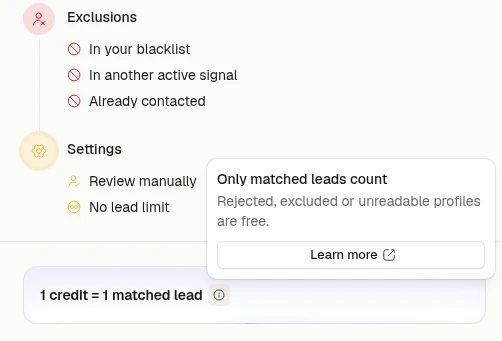
What that means for your cost per lead:
- Profiles that don't match cost nothing. A profile a signal looks at but doesn't keep, or one your exclusions skip, uses no credit.
- A rejected lead gives its credit back, unless a campaign has already contacted it.
- A person matched again by another signal uses another credit.
- Everything after the match is included: campaigns, messages, the shared inbox and teammates cost nothing more, and there is no setup fee.
- Extra credits are optional: packs of 250, 500 or 1,000 that never expire.
So one account's subscription buys up to 500 leads a month that fit your ideal customer, and its cost per matched lead falls as you use the credits. The comparison with a search lead stops at that stage: a matched lead hasn't replied yet. It still has to accept your invitation and answer your message, and the hours you spend writing sequences and answering replies are the main cost of the channel. Count them in your fully loaded figure.
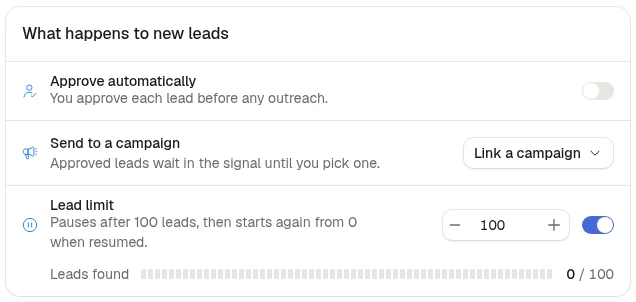
To keep a signal inside a budget, turn on its lead limit: the signal pauses after that many leads, so it can't use more credits than you planned. Leads you reject don't count toward the limit.
Done for you prices the work instead of the lead. Our team builds qualified lead lists, writes the sequence and runs your LinkedIn outreach, with 700 connection requests a month, a follow-up call twice a month and a weekly results report; you take the meetings. The commitment is agreed on the strategy call, and spots are limited each month. See both plans and their per-account prices.
How do you set a lead generation budget tied to revenue?
Work backwards from the customers you need, with your own conversion rates, then check the result against what a customer is worth. Five steps:
- Set the target: new customers a month.
- Turn it into meetings, qualified leads and leads with your close rate, your meeting rate and your qualification rate.
- Price those leads at the cost per lead of each channel you plan to use.
- Check capacity: can your team hold that many meetings and follow up on that many leads?
- Compare the cost per customer with the gross margin a customer brings over the period you care about. If it costs more than it brings, change the channel, the rates or the target.
With the example rates of this guide, 4 new customers a month take 16 meetings, 48 qualified leads and 192 search leads. At $93.69 a lead, that is $17,988.48 of ad spend a month, or $4,497.12 per customer before any staff time.
Then review the same five numbers each month, per channel: spend, leads, qualified leads, meetings and customers. If volume rises while qualified contacts or meetings fall, find out why before you raise the budget. When you change a channel or a qualification rule, note the date, so next month's figures read fairly. If a channel needs a different tool, our guide to picking a lead gen tool covers ten of them by the job they do.
Price the lead your sales team can use
The cost of lead generation only means something per qualified lead, per meeting and per customer. At the example rates of this guide, a $93.69 search lead in business services costs over $1,100 per meeting held, about what an SDR at quota costs. Fix your lead definition first, label channel-only and fully loaded figures, and compare channels at the same stage. If LinkedIn is one of them, compare Sendable's plans on the leads they bring and the time they leave with you.
Sources
- WordStream (LocaliQ), Google Ads Benchmarks 2026, updated September 16, 2026: median cost per lead, cost per click and conversion rate of 13,474 US search campaigns on Google Ads and Microsoft Ads, April 1, 2025 to March 31, 2026, and Kevin McClary's quote.
- The Bridge Group, 2025 SDR Models & Metrics Report, February 6, 2025: SDR on-target earnings ($80,000), monthly quota (10 meetings held), quota attainment (60%), ramp (3.0 months) and tenure (1.9 years), across 351 B2B companies.
- US Bureau of Labor Statistics, Employer Costs for Employee Compensation, June 2026, released September 9, 2026: wages and benefits per hour worked in private-industry sales jobs.
- SHRM, 2025 Recruiting Benchmarking Report: median cost per hire of $1,200 for nonexecutive roles.
- Understanding Data Collection, Brokerage, and Spam in the Lead Marketing Ecosystem, arXiv, April 8, 2026: leads bought from three lead platforms, sold to unvetted buyers, augmented or fabricated.
- Sendable, Managed outreach cost: LinkedIn pricing vs. SDR hiring: the first-year SDR cost built from the three sources above, and the published prices of managed LinkedIn outreach services, November 2026.
FAQ
How much does lead generation cost?
It depends on the channel and on what you count as a lead. US search ads cost a median $66.69 per lead in 2026 on Google and Microsoft Ads, and $93.69 for business services (WordStream). A full-time SDR costs about $126,000 in the first year, and LinkedIn prospecting software such as Sendable costs $69 per LinkedIn account a month.
How do you calculate cost per lead?
Divide the spend you are measuring by the leads generated over the same period. For cost per qualified lead, divide by the leads that meet the criteria you set beforehand. Say which costs you counted: media only, or media plus staff time, software and data.
What is a good cost per lead for B2B?
One that still leaves a profit once your conversion rates are applied. A $93.69 search lead is cheap if 1 lead in 2 books a meeting and expensive if 1 in 20 does. Compare channels on cost per meeting or per customer, against the margin a customer brings.
Is cost per lead the same as customer acquisition cost?
No. Cost per lead measures what a contact costs on one channel, while customer acquisition cost divides all sales and marketing costs by the new customers they bring. Divide your cost per lead by your conversion rates from lead to customer, then add the cost of selling, and you get close to your acquisition cost.
How does Sendable charge for LinkedIn lead generation?
Pro costs $69 per LinkedIn account a month before VAT, with 500 credits per account: each lead a signal matches to your ideal customer uses one credit, and profiles it doesn't keep are free. Done for you costs $1,500 a month for the first LinkedIn account, and our team runs the outreach while you take the meetings.