
Intent data is any behavioral signal that suggests a person or a company is looking into what you sell, before they ever contact you. That is the whole definition. Everything else is a question of where the signal comes from, how fresh it is, and whether you can act on it today.
I run a LinkedIn prospecting agency. My team contacts thousands of profiles every month for our clients, so I read this subject from the side of the person who has to write the first message, not the side of the vendor who sells the feed. Most B2B intent data content skips that part, and that is exactly where the money is made or lost.
The page moves from the general to the specific: the four sources of intent data, the difference between a feed and a single intent signal, why purchase intent is not the same thing as fit, and the loop I use to turn a signal into a first line that does not read like a template.
What intent data means in B2B
A prospect does something observable. A team downloads a comparison guide, a company posts a job ad for a role that only exists when a problem exists, a director visits your pricing page twice in a week. Each of those is a behavior you can see from the outside. Collected and attached to a company or a person, those behaviors become intent data.
Two things follow from that definition, and both matter more than any feature list.
First, the signal is probabilistic. It says "more likely than the average company on your list", not "ready to buy". A team reading about CRM migration might be doing research for a blog post. Treat every signal as a reason to look, not as a qualified lead.
Second, every signal has a shelf life. A pricing page visit is worth something for about a day. A funding round is worth something for a quarter. If your process takes two weeks to move from signal to message, most of your data is expired by the time you use it.
The four types of intent data
Vendors group the category in different ways, but the split that decides what you can do with a signal is the source. Demandbase uses the same first party and third party frame in its intent data FAQ, and Bombora built the reference implementation of the third party model. Most vendor definitions stop at three types. I add a fourth, because it is the one a small team can use this week.
| Type | Where it comes from | What it tells you | Resolves to | Freshness |
|---|---|---|---|---|
| First party | Your own site, product, docs, emails | This person or company is looking at you | Company, sometimes a person | Same day |
| Second party | A partner's property: review site, publisher, community | This account is comparing vendors in your category | Company | Days |
| Third party | A network of publisher sites across the open web | This account is reading about your topic | Company, by topic | Weekly |
| People and event signals | Job posts, job changes, funding, LinkedIn posts and comments, profile views, events | This person or company just changed something | A named person | Same day |
First party intent data is behavior on property you own. Website visits, repeat visits, docs pages, trial activity, email clicks. It carries the highest intent of the four, because they came to you, and you already have the raw material. The work is turning an anonymous visit into a company name and getting it in front of someone before the day ends. The limit is volume: a young company gets little traffic, so first party data alone rarely fills a week of outreach.
Second party data is another company's first party data, shared with you commercially. The classic case is a review site telling you who compared you against a competitor last week. Narrow, but the intent is unusually clear.
Third party data is aggregated content consumption across a publisher network. A vendor tells you that a company showed a surge in reading about your topic. It is anonymous by construction, which is why it lands on the company and not on a person. Useful for planning, hard to act on directly.
People and event signals sit outside most vendor definitions, and for a small team they are the most useful group of all. They are public by design: a job ad, a job change, a post, a comment under a competitor's announcement. You can watch them for free, they arrive with a name and a job title attached, and you can mention them in a first message without sounding like you were spying. A company that posts its first sales operations role has a process problem right now, with a budget behind it. I broke down the ones I use week to week, with the opening line that goes with each, in how to identify buying signals.
Intent signals vs intent data
People use the two terms loosely, and the difference is worth a minute. Intent data usually means the aggregated feed a vendor sells you: many observations rolled up into a score per account. An intent signal is a single action you can see and name yourself: one job post, one profile visit, one comment under a competitor's post. Intent data tells you a company is warming up somewhere in your market. A signal tells you which person to write to and what to open with.
Demandbase describes intent signals as the behavioral data that shows which accounts are researching a topic, which is the account view of the idea. For outbound I add one condition: a B2B intent signal is only useful if it is public enough to name in your first message. "I saw you are hiring a sales ops lead" works. "Our data provider says your company is surging on CRM topics" does not, and nobody should send it.
Signals do not all weigh the same either. A strong signal means the person is dealing with your problem right now: hiring for it, researching it, posting about it. A weak signal means they only look like a buyer (right role, right industry, right size) with nothing saying the problem is urgent today. That second case is not intent at all, it is fit, and the next section keeps the two apart.
Account level or person level
Ask one question about any source: does it give me a company, or does it give me a person?
Account level data tells you a company is in market. That is genuinely useful when you have a marketing team, an ads budget, and a CRM someone maintains. You raise bids on those accounts, you send them a campaign, you tell sales to prioritize them.
But if you are a founder or a two person sales team, an account level surge leaves you with a second job: figuring out who inside that company to contact, and what to say to them. Most of the effort in outbound sits in that gap. Account intent narrows a list of ten thousand companies to four hundred. It does not write your first line.
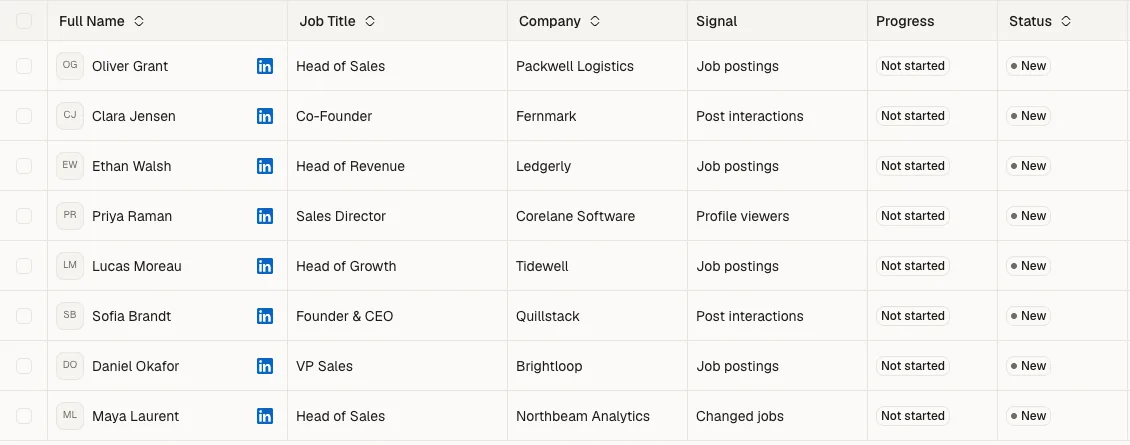
Person level signals skip the gap. Someone changed jobs, posted about the problem you solve, viewed your profile, registered for a webinar on your topic. You know who they are and you know why you are writing. If you have to choose one and you are small, choose person level. You will send fewer messages and get more conversations.
Intent vs fit
Purchase intent is the likelihood that a person or a company buys soon, read from what they do rather than what they say. Fit is whether they belong on your list at all. Founders mix the two up constantly, and it costs them replies.
| Fit | Purchase intent | |
|---|---|---|
| Question it answers | Should I sell to them? | Are they looking now? |
| Source | Firmographics, role, industry, company size | Behavior and events |
| Changes over time | Slowly | Fast, and it decays |
| Use it for | Building your list | Timing your outreach |
Fit tells you who belongs on your list. Intent tells you who to contact this week. You need both. A high fit prospect with a fresh signal is worth a personal message today. A high fit prospect with no signal waits until something wakes them up. And a loud signal on a company you cannot serve is noise with better packaging, however urgent it looks.
The buyer intent funnel in three stages
Marketers map purchase intent onto three stages, and knowing which stage a signal belongs to tells you what to say. Demandbase walks through the same three stage model in its guide to buyer intent.
- Awareness. The buyer feels a problem but is not shopping yet. Signals are soft: following the topic, reading educational posts, a job change into a role that owns the problem. A pitch here feels early. A useful question or resource works better.
- Consideration. The buyer is comparing options. Signals include a comment under a competitor's post, a review site comparison, a public post asking for recommendations. This is where a relevant, well timed message does the most work.
- Decision. The buyer is choosing a vendor. Signals are hard to miss: repeat pricing page visits, a demo request, a public complaint about the tool they are about to replace. Be direct and be quick, because others see the same thing.
The rule for outbound fits in one line: match the message to the stage, and never send a decision stage pitch to someone who is still at awareness.
Where B2B intent data actually comes from
Sources vary in quality far more than vendor pages admit. This is roughly how I rank them for a small outbound team.
| Source | Signal quality | Freshness | Person level |
|---|---|---|---|
| Your own pricing and docs pages | High | Minutes | Sometimes |
| Job postings | High | Days | Yes, the hiring manager |
| Funding and headcount changes | Medium | Weeks | Yes |
| LinkedIn activity: posts, comments, profile views | Medium to high | Hours | Yes |
| Review site comparisons | High | Days | No |
| Publisher network topic surges | Medium | Weekly | No |
| Technographic installs | Low as intent, useful as a filter | Months | No |
One source is missing from that table on purpose: the words people type into a search engine before they ever land on you. You cannot see them prospect by prospect, but the vocabulary tells you which problems are live in your market, and the same phrases show up in job ads and LinkedIn posts. I collected them in buyer keywords.
Two notes on the table itself. Technographic data ("they use HubSpot") is not intent, it belongs in the fit column. Using it as intent is the most common way teams convince themselves a cold list is warm. And publisher network surges are only as good as the topic taxonomy behind them, which is why two vendors can disagree completely about the same account.
If you plan to pay for any of this, decide first which row you are buying. Account level feeds, visitor identification and topic surges come from a crowded group of vendors, mostly on annual contracts with private prices; I compared them, with the prices that are public, in intent data providers. Person level signals delivered straight into outreach are a different kind of product, reviewed separately in buying signals software. Either way, ask one question before the demo: how does the signal leave the tool? Data that lands in a dashboard nobody opens is worth nothing.
How to use intent data without a marketing team
Here is the loop I run. Five steps, no revenue operations hire required.
1. Pick one trigger you can see reliably. Not seven. One. Job ads for a specific role, or funding rounds in your segment, or people who viewed your profile. A single trigger you check every week beats a data platform you log into twice.
2. Filter on fit before you read the signal. Company size, market, geography, language, role. Cut first, then read what the remaining people did. This is the fit column of the table above doing its job.
3. Write the first line from the signal itself. This is the part tools cannot do for you, and it is the part that decides your reply rate. The signal has to be visible in the message, and the message has to be about them.
Weak, because it could be sent to anyone who ever clicked on one of your posts:
Hi Priya, thanks for engaging with my content! We help B2B teams book more meetings. Open to a quick call?
Better, because it could only go to one person:
Priya, you voted "still by hand" on my poll about how teams build prospect lists. Out of curiosity, which part takes longest on your side: finding the companies, or finding the right person inside them? Happy to share what I have seen work for teams your size.
4. Act inside the freshness window of the signal. Same day for a site visit, same week for a job ad, same month for a funding round. Late is the same as never, except you also burned the contact.
5. Keep only the signals that beat a cold list. Measurement is not the score a vendor prints on a dashboard. Over a few weeks, compare the reply rate of the people sourced from each signal with the reply rate of a plain cold list in the same segment. If a source does no better, it is not a signal for your product, however good it looks in theory. Start with two or three sources: you cannot measure ten by hand, and you would end up trusting none of them.
Steps 1, 2 and 4 are mechanical, and they are what auto prospecting tools take off your plate: watching the trigger, applying the filter, starting the sequence on time. Steps 3 and 5 stay with you.
The privacy question, honestly
Third party data works by observing behavior across sites people do not know are connected. In Europe that runs into the GDPR, and the usual vendor answer is that the data stays at the company level and is therefore not personal data. That answer is fine until a signal resolves to a named individual, which is exactly what makes person level data useful.
The practical position I take: prefer signals a person published on purpose. A job ad, a public post, a profile view, a webinar registration, a vote on your own poll. Those are visible by design, they are easier to defend, and they make a better first message anyway, because you can reference them out loud without sounding creepy.
Where Sendable fits
Sendable, the product I am building with my cofounder, lives in the fourth row of the types table, plus the LinkedIn slice of the first. It does not sell an account level feed. It watches person level signals on LinkedIn, sixteen of them today:
- Your own first party signals on LinkedIn: profile viewers (LinkedIn Premium needed on the account), profile followers, followers of the company pages you administer, newsletter subscribers, voters on your polls filtered by answer, attendees of your LinkedIn events, and your 1st degree connections.
- Public people and event signals: people at companies hiring for the roles you search, or whose job posts mention a keyword, people who changed jobs in the last 90 days, people who posted in the last 30 days, and people who reacted to or commented on posts you pick, posts matching a keyword, or posts from influencers you choose.
- Two ways to start from a list: people LinkedIn suggests in "People you may know", and a CSV import when you already have a qualified list.
Each person is filtered with AI against the customer you describe, and the ones that fit go into a LinkedIn sequence you build (invitation, messages, delays, conditions), with a shared inbox and analytics across several LinkedIn accounts. Sendable automates the detection, the filtering and the sequence. You write the messages and you answer the replies, which is the part this page argues should stay human anyway.
What it is not: a topic intent platform across the open web, and not an email tool. It is LinkedIn only. If you need account level surges to feed an ads budget, one of the account level providers is the better shape. Pricing is $49 per connected LinkedIn account per month, or $490 per account per year, the same for every account you add. You can read how Sendable turns LinkedIn signals into conversations, or test it on your own market with a 7-day free trial, no card.
FAQ
What is B2B intent data?
B2B intent data is behavioral data showing that a company or a person is researching a product category. It comes from your own site, from a partner's property such as a review site, from a network of publisher sites across the open web, or from public people and event signals such as job posts and LinkedIn activity. It indicates likelihood, not a decision, so it is best used to prioritize who you contact and when.
What is the difference between intent signals and intent data?
An intent signal is one observable action, such as a job post, a profile view or a comment under a competitor's post, that you can name in a message. Intent data is the aggregated feed built from many such observations, usually sold as a score per account. Signals tell you who to write to and what to say; intent data tells you which accounts are warming up.
What is the difference between first party and third party intent data?
First party intent data is behavior on property you own: your site, your docs, your product. You already have it and it is the freshest signal you will ever get. Third party data is content consumption observed across external sites, sold by a vendor, and delivered at the company level. First party tells you who is looking at you; third party tells you who is looking at your category.
What is the difference between purchase intent and fit?
Fit is whether a prospect belongs on your list, based on role, industry and company size, and it changes slowly. Purchase intent is whether they are looking to buy right now, based on behavior, and it changes fast. Use fit to build the list and intent to time your outreach.
What are the strongest B2B buyer signals?
Job postings, job changes, profile visitors, and engagement on competitor content. All four combine clear intent with easy person level targeting, so you can write a first message that mentions the exact signal.
Is intent data accurate?
It is directional. Third party topic surges tell you a company read more than usual about a subject, which can mean a buying committee, a curious intern, or a competitor. Accuracy improves when you combine a signal with a fit filter and act quickly. Judge any provider on a sample of your own accounts, not on a case study.
How much does intent data cost?
Account level platforms sell annual contracts and rarely publish prices, so budget for a five figure yearly commitment and a procurement cycle. Tools built around person level signals more often publish a monthly price. A published price is a decent proxy for whether a product was designed for a team of your size.